
How universities can make a big splash in search with a small budget
Bethany Plint explains how focusing on these three opportunities can unlock big returns on a small-but-smart investment in education content.
SIGN UP FOR OUR NEWSLETTER
What you need to know:
- Smaller universities are winning in search because of their clever investment in content.
- Showcasing real student stories brings the authenticity, originality and authority LLMs and search engines are looking for.
- Leveraging your internal experts (i.e. academics!) can unlock a huge content opportunity.
- Repurposing content across channels can help you cover the full search experience, increasing your visibility across channels.
Big budgets don’t guarantee impressions and clicks in search.
Showcase real student stories
Content can be tricky for the education sector. You’re not selling a product. You’re selling possibility – a future career, a new direction, a higher salary. That’s a big promise, and you need proof to back it up.
Future students need to see themselves in your content. Real, honest stories from people who’ve been where they are – and landed where they want to be – are some of the most powerful tools in your arsenal.
Here’s a great example.
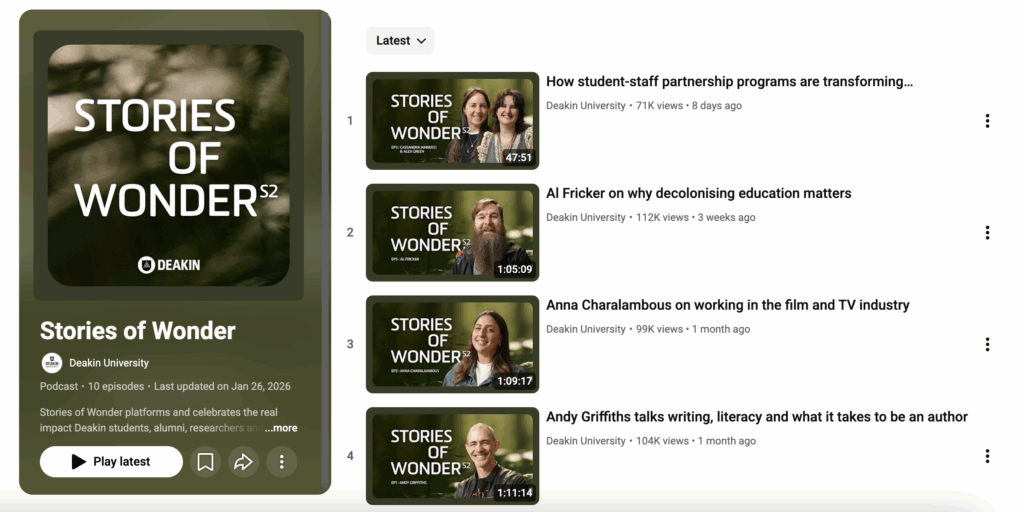
Deakin University’s YouTube channel is a treasure trove of student stories. Their ‘Stories of Wonder’ series interviews members of the Deakin community, including students, alumni and academics, deep-diving into their full university journey and beyond. From studying their degree to gaining work experience through uni-supported programs, to landing a job after graduation, the interviews show you rather than simply tell you what’s possible – all from the trusted perspective of a student.
The reason these stories are so valuable is because they naturally contain the exact language prospective students use when they search: “Is this degree worth it?” “What’s it like studying online?” “Can I work while studying?” “What job can I get after graduation?”
This kind of first-hand content sends strong quality signals to search engines and tools like ChatGPT – especially when the story includes specific details (degree name, career outcome, location). That means more chances of being surfaced in AI Overviews, long-tail queries and “comparison-style” searches. This is where smaller unis can genuinely outrank bigger brands.
Don’t have the budget to rent a podcast studio and video equipment?
Lo-fi versions work well, too! The execution is important, but the story is what matters most. Vox pops on campus, shot with your phone, could be a great way in. Get some engagement, prove it works and push for budget to develop some higher production-value content.
Tap into your expert network
If you’re not already using your lecturers, alumni and academic staff in your content, you’re missing a huge opportunity.
Your academics and alumni are sitting on a content goldmine. They have insights that build trust and credibility. They can explain complex topics in a relatable way, and they can show that your institution is home to some powerhouse thought leaders.
But in 2026, there’s another critical reason to leverage your experts. Search engines and AI tools are drowning in rinse-and-repeat content. They’re starving for something new – which is why they increasingly reward content that shows real expertise, unique opinions and first-hand experiences.
‘Information gain’ is the new currency of search.
That means adding something new, specific or genuinely useful to the conversation. And expert-led content does exactly that.
The problem is, most marketing teams don’t have the time (or relationships) to tap into this well of knowledge consistently. That’s where a little proactive planning goes a long way.
To effectively leverage your internal experts, try these tactics:
- Give them a heads up: at the start of the month or quarter, reach out and let them know your plans – that you’d love their input and will be tapping them on the shoulder in the coming weeks.
- Help them prep: no one likes a meeting with no agenda. Jot down some talking points or, even better, supply a rough Q&A in advance so they know what they’re walking into.
- Follow up: let them know once the piece goes live so they can share it with their network. That boosts your off-page SEO and drives quality traffic from networks you may not even be targeting.
- Share the love: If you get great feedback on the content, pass it along! They’ll be more likely to say yes again next time.
Repurpose your content across the full search experience
We can’t talk about content in 2026 without mentioning how different the world of search looks today. Search Experience Optimisation (SXO) is the modern evolution of SEO – and it’s crucial for universities that want to be visible in all the places prospective students search.
That includes traditional search engines like Google, AI-driven tools like ChatGPT and Google’s AI-enabled search, and social media platforms like TikTok, YouTube and Instagram.
SXO is about making sure your content shows up everywhere, not just your website.
Take one high-quality piece of content – say, an interview with your Engineering faculty’s most prominent researcher – and turn it into a juicy package of repurposed content.
For us, a well-planned 1-hour interview can feed into multiple blogs, videos, social content and more. This variety of formats multiplies your chances of appearing in the places where your audience spends most of their time.
Clever repurposing enables the kind of scale that small marketing teams need to compete with the big-budget unis.
Don’t sleep on the fundamentals
In theory, big universities have more budget, awareness and authority to help them rank in search. But the downside is that they often have massive websites with years of legacy content. That can make them slow to fix and hard to govern.
Smaller unis have an advantage here. Your website should be easier to audit and optimise, leading to faster SEO wins.
If you want to get your fundamentals up to scratch, prioritise the following:
- Clean up your metadata – we’ve seen major uplifts from fixing hygiene issues like missing metadescriptions or too-long titles.
- Simplify your site architecture – check things like your sitemap and indexed pages. Make it easy for prospective students and search tools to navigate and understand your website hierarchy.
- Review your page structure – the way your content is structured matters almost as much as the content itself. Aim for consistent structure across similar content types, using clear headings, scannable body copy and formatting that resembles common SERPs, like tables and lists.
- Prune your content – Update, merge or remove thin content – if a page has less than 300 words, how much value is it really adding?
Do you want to create better education content in 2026?
At Wonderthink, we know education content. And we know what it’s like when your marketing team feels stretched. We offer strategy, implementation and training for teams who need a little (or a lot of) help getting their content to cut through.
Keen to chat? Get in touch here or email [email protected].
You may also like

Low-fat content is killing your brand in search
SEO content has gone low-fat – technically correct, utterly unsatisfying.
READ MORE
How education providers can compete in search
You don’t need to have a huge budget to make a splash in search.
READ MORE