
Thought leadership delivers 156% ROI. Could AI undermine its value?
More businesses are thinking about outsourcing their thought leadership content to AI, but doing so risk losing the very qualities that make it valuable.
Andrea Warmington dives into the latest research on the commercial value of quality, human-led thought leadership content.

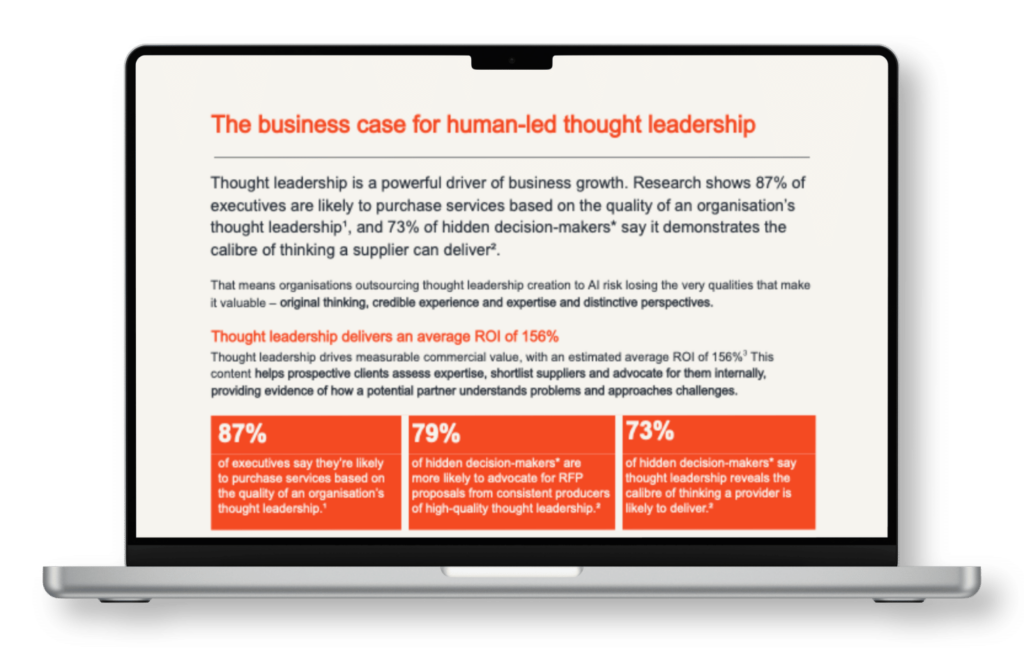
Need help making a case for human-led thought leadership content? Just enter your email below, and we’ll send you a one-pager.
Don’t worry – we won’t share your email address with anyone, and we’ll only ever email you the good stuff.
Thought leadership is a powerful driver of business growth. Research shows that 87% of executives are likely to purchase business services based on the quality of an organisation’s thought leadership, and 73% of hidden decision-makers* say it demonstrates the calibre of thinking a supplier can deliver.
But as AI makes it faster and cheaper to produce content, organisations outsourcing thought leadership creation to AI risk losing the very qualities that make it valuable – original thinking, credible experience and expertise and distinctive perspectives.
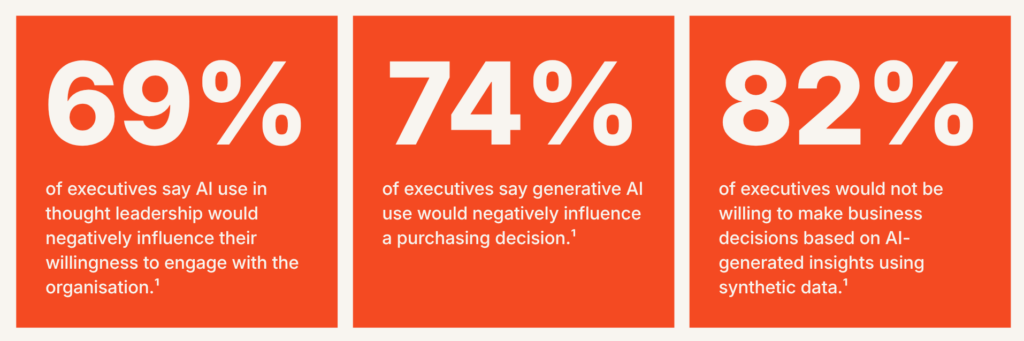
Recent research found 69% of executives say the use of AI in thought leadership would negatively influence their willingness to engage with the organisation producing it. In this article, we explore why we need to leverage human expertise to produce thought leadership content, while using AI strategically to improve production efficiency.
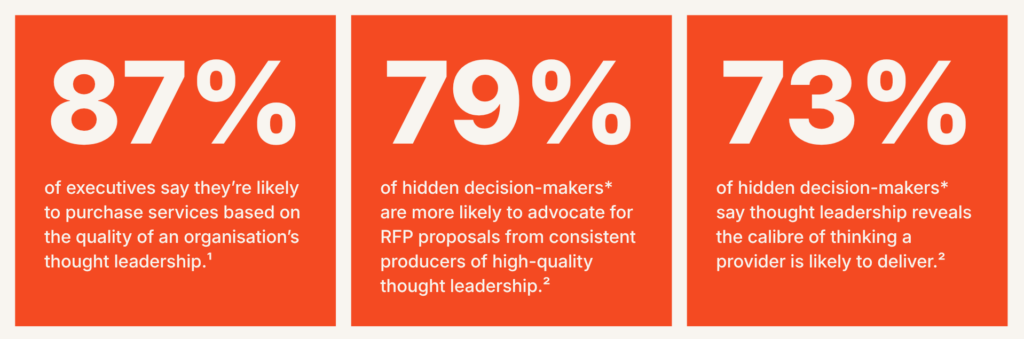
Thought leadership delivers an average ROI of 156%
Yes, you read that right. Thought leadership is more than a brand-building exercise – it delivers measurable commercial value.
Research published in The ROI of Thought Leadership: Calculating the Value that Sets Organizations Apart found that thought leadership programmes deliver an estimated average ROI of 156%, helping prospective clients assess expertise, shortlist suppliers and advocate for them internally.
Buyers are not only evaluating an organisation’s technical capabilities; they’re looking for evidence of how a potential partner understands problems and approaches complex challenges. Thought leadership gives them a window into that expertise before an engagement begins.
The value of thought leadership is in original thinking
More than 70% of executive consumers identified originality, a unique perspective and proprietary data as key markers of quality thought leadership content.¹
Research increasingly suggests that relying on AI to generate ideas can lead to more homogeneous content, undermining the differentiation organisations are trying to achieve. A 2026 study found that AI-generated creative responses were significantly more similar to one another than human-generated responses.
For organisations, the implication is clear: relying too heavily on AI to develop creative angles risks producing thought leadership that looks increasingly similar to competitors’ content. Human expertise and editorial creativity are essential to developing distinctive perspectives.
Over-reliance on AI-produced content can put brand trust at risk
Executives who value thought leadership are cautious about how generative AI is used to produce it.
The Global Thought Leadership Institute surveyed 1,000 executive consumers of thought leadership and found a substantial negative reaction to AI use in this context.¹ These attitudes indicate a substantial reputational and commercial risk when AI replaces the expertise audiences expect.
Discoverability also matters: Research by Graphite found that 86% of articles ranking in Google Search and 82% cited by ChatGPT and Perplexity were classified as human-written.³
AI can improve efficiency – but human expertise must remain at the centre
The most effective approach to thought leadership combines subject-matter expertise, editorial judgement and targeted AI support. Subject matter experts contribute first-hand experience, original insights and professional judgement. Experienced writers draw out distinctive perspectives, develop original creative angles and shape expert knowledge into compelling thought leadership.
AI can create efficiencies throughout the process through research, transcription, outlining and content repurposing – but it cannot replace the human expertise, creativity and original thinking that makes it thought leadership in the first place.
“AI can only reflect what it has been trained on,” said Cindy Anderson, co-author of The ROI of Thought Leadership, in an interview. “The real value of thought leadership is taking original data, applying analysis, and conceiving an original thought. While AI is useful in many ways, at the moment, it’s not equipped to produce thought leadership in the way that we traditionally think of it: original insights that help make better business decisions.”
¹ Global Thought Leadership Institute / APQC (2026), Promise and Peril: How attitudes to and practices in thought leadership are changing in the era of AI. ² Edelman–LinkedIn (2025), 2025 B2B Thought Leadership Impact Report. ³ Anderson, C. and Marshall, A. (2025), The ROI of Thought Leadership: Calculating the Value that Sets Organizations Apart (2025). ⁴ Graphite , AI Content in Search and LLMs (2026).
*Hidden buyers are stakeholders who influence purchasing decisions but may not have direct contact with potential suppliers, as defined in the 2025 Edelman–LinkedIn B2B Thought Leadership Impact Report. They help evaluate options and make recommendations to those with final purchasing authority.
You may also like

Thought leadership delivers 156% ROI. Could AI undermine its value?
More businesses are thinking about outsourcing their thought leadership content to AI, but doing so
READ MORE
Why I wrote Spark Wonder at Work
Discover why author Brooke Hill wrote Spark Wonder at Work and how cultivating wonder, curiosity
READ MORE